

Most measurement problems found in an audit are not bad meters. They are good meters with a missing piece of paper: the schematic that was updated but not saved, the calibration sheet that lives on one technician’s laptop, the flow computer change nobody wrote down. Alberta’s measurement directive is clear about what has to be kept, and the periods are shorter and longer than people tend to assume.
What the directive says to keep, and for how long
The Alberta Energy Regulator reissued Directive 017 on September 28, 2026, replacing the December 2024 edition. The change in this edition is narrow: the monthly gas plant sulphur balance report is now submitted through Petrinex rather than the older data submission system. The record rules below read the same as before, but the new edition is the one an auditor will hold you to.
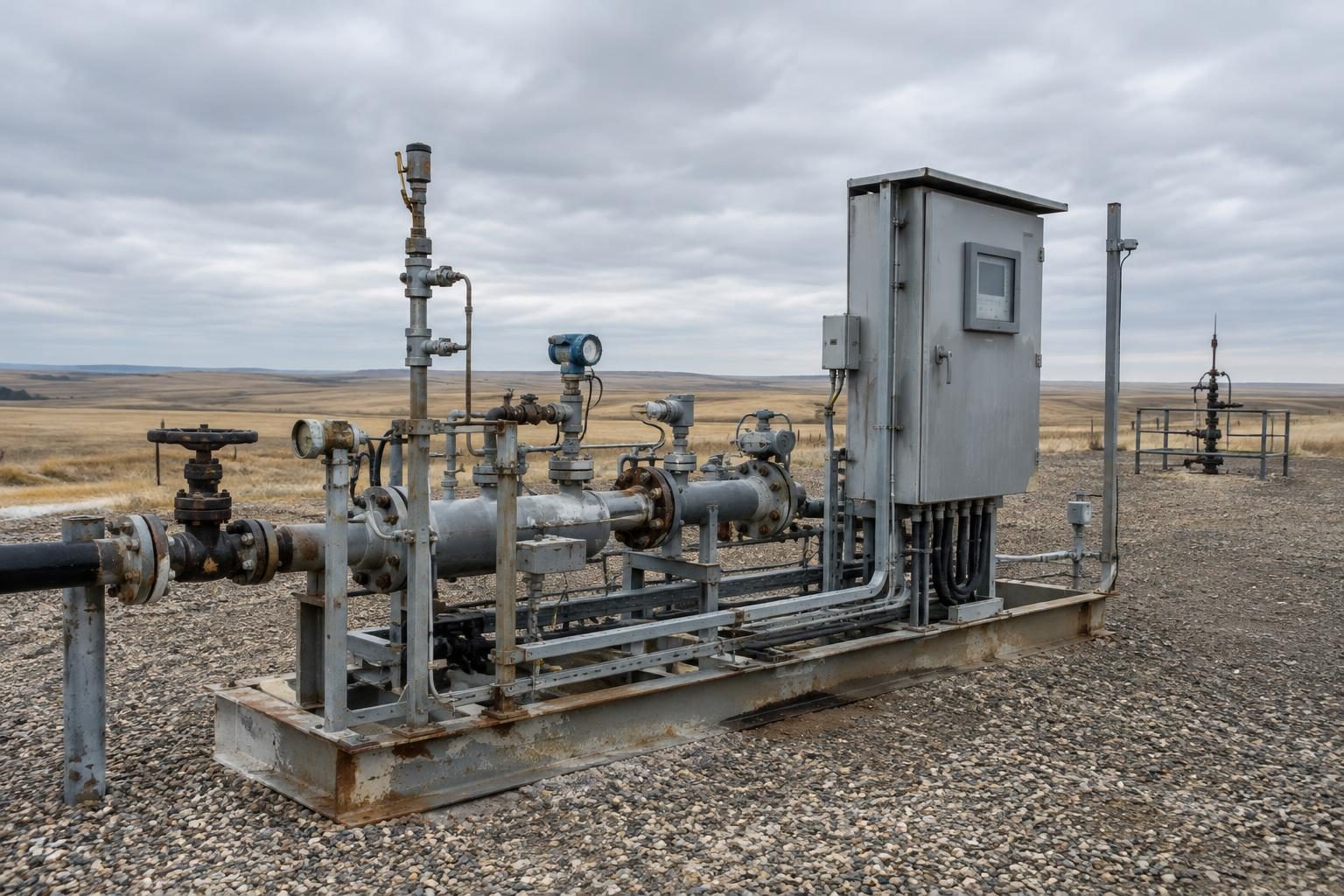
- Measurement schematics. A master copy is kept at a central location, and earlier versions are stored for at least 18 months. Electronic or paper is the operator’s choice.
- Electronic flow measurement. All data and reports are kept for at least 12 months. When anything that affects the flow calculation changes, such as an orifice plate size, a meter factor, a fluid analysis or a transmitter range, a sign-off procedure or an event log has to show that the change was made in the system.
- Extended calibration intervals. Where a digital transmitter qualifies for a longer verification interval, the records that earned it are kept for at least five years and handed over on request.
- Original charts. Where charts are still in use, the originals are kept for at least 12 months (18 months for gas from heavy oil or bitumen), or a locked scan is stored in two copies, one of them off site.
Where the gaps usually are
Proving frequencies are the easiest place to lose the thread. A live oil meter at a well or battery is proved annually. A meter at a gas plant inlet is proved semiannually. Dead oil and delivery point meters are monthly, with a quarterly option when the volume is small or the last three meter factors agree within half a percent. Each exception only holds while the evidence stays on file, and it reverts to monthly the moment a factor drifts. A calendar reminder will not remember that; a record has to.

The second gap is the link between the field and the accounting office. A transmitter is recalibrated, the flow computer is updated, and the production accountant keeps using last quarter’s assumptions. The directive expects the schematic, the field settings and the accounting inputs to describe the same facility.
Why scattered files stop working
A handful of meters can be managed with a shared drive and discipline. Past a few dozen, versions multiply and nobody can say which proving report is current. That is the point where operators begin looking at oil and gas measurement software that holds schematics, proving history and sample results in one record set with a trail of who changed what. The software does not make a meter more accurate. It makes the paper trail easy to produce when someone asks for it.
Whatever you use, test it with one question: if the regulator asked today for the last three proving reports for a single battery, along with the schematic as it stood a year ago, how long would it take to find them? Standards bodies such as API publish the measurement methods the directive builds on, and reading them alongside the record rules is a useful annual habit.
A short audit-readiness list
- One current schematic per facility, with earlier versions retained for 18 months or more.
- A change log for every flow computer setting that touches a volume.
- The last proving or calibration report for each meter, matched to its tag.
- Records for any meter running on an extended interval, held for five years.
- A named person who checks the list each quarter.
None of this is glamorous, and all of it is cheaper to keep than to reconstruct.



 Mainly energy service organizations center on reducing energy usage and saving organizations on energy expenditures by a range of ways which includes moderating energy consumption and discount rate negotiations with regards to energy supply management companies. In the 1990’s with deregulation we saw the rise of ESCOs then activities slowed down during the Obama administration we witnessed reversals of regulations only to again be deregulated by the current
  Since its introduction in the 1990’s, a single US federal government program known as “